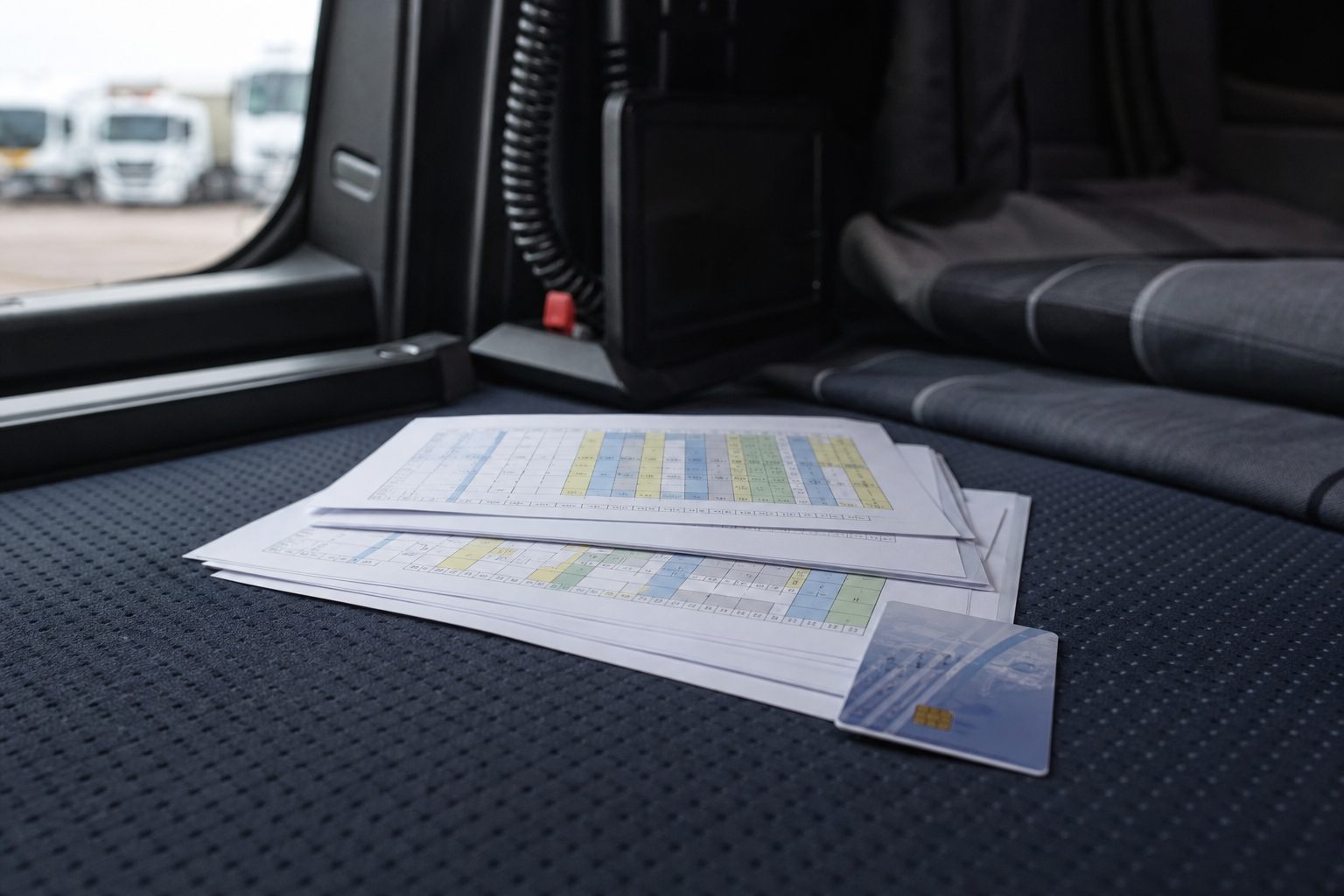
Weekly 56-Hour and Fortnightly 90-Hour Driving Limits
Even if every single day looks fine, the week can still be illegal. Assimilated rules cap driving at 56 hours in a week and 90 hours in any two consecutive weeks.

Latest news, guides and updates for professional HGV drivers.
Even if every single day looks fine, the week can still be illegal. Assimilated rules cap driving at 56 hours in a week and 90 hours in any two consecutive weeks.

A regular daily rest is 11 hours. You may reduce to 9 hours — up to three times between weekly rests. Here is that reduction on its own (not the 3+9 split).
Multi-manning is not “two people in the cab so rules disappear”. Both cards must be in correctly, and the duty window stretches in a specific way — with clear limits for the non-driving driver.
You can interrupt a qualifying rest to drive on or off a ferry or train — but only within tight limits. Bunk access, two interruptions, 60 minutes total, and correct Ferry/Train recording.
After 4.5 hours of driving you need a break. The full break is 45 minutes — or 15 then 30, in that order. Here is the break rule on its own, without turning into a POA or daily-rest guide.
Most days you may drive 9 hours. Twice in the Monday–Sunday week you may extend to 10. That is not the same clock as reduced daily rest.
The 10-hour night work limit is a working-time protection for mobile workers — not a casual opt-out like some 48-hour average clauses. See what counts as night work and who can change the limit.
Article 12 is a safety valve, not a planning tool. See when you may exceed daily driving time, by how much, and what you must record.
Split daily rest is optional flexibility — not a free-form nap pattern. The 3-hour block must come first, then 9 hours, inside the 24-hour window.
You can reduce a weekly rest — but the missing hours do not disappear. Calculate the debt, attach it to a 9+ hour rest, and finish before the end of the third following week.
Period of Availability is not a break and it does not reset your driving-time clock. Here is when POA is legal — and the exact mistake that creates infringements after 4.5 hours.
Across much of Europe the common legal floor is 1.6 mm. Cross-border drivers also need seasonal extras — without treating every country as identical.
In Great Britain, goods vehicles and trailers over 3.5 tonnes must keep at least 1 mm of tread across the required band. What that means in practice — and what follows if you ignore it.
A poor stop can mean stolen cargo, a damaged trailer, or a rest you cannot use. Use this practical list before you commit.
DVSA roadside checks often catch recording errors, not “unknown rules”. Here are the mistakes that trigger delays and penalties — and a 2-minute checklist before you leave the yard.