UK truck and trailer tyre tread: the 1 mm legal minimum
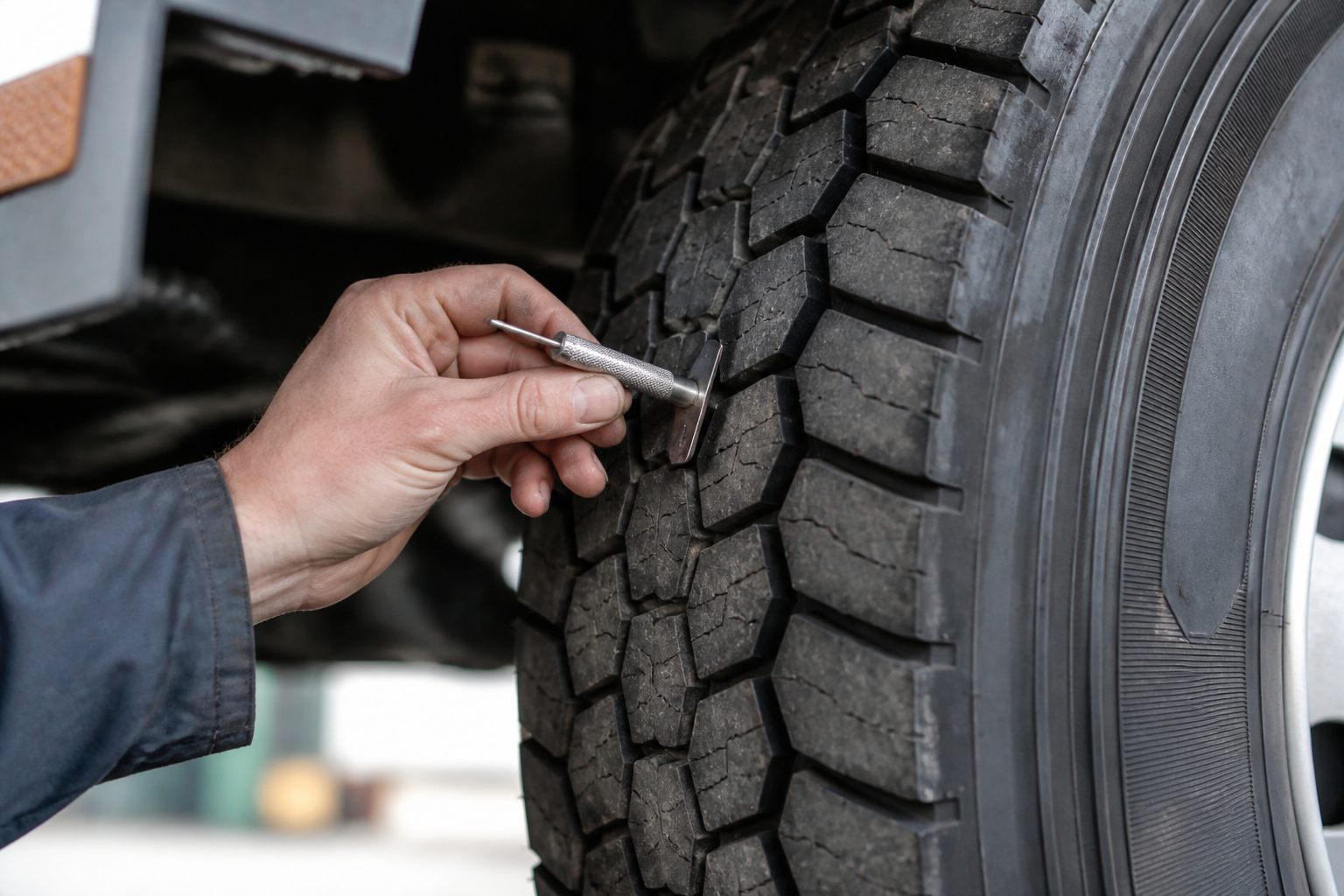
The legal minimum for HGV and trailer tyres
In Great Britain, the legal minimum tread depth for goods vehicles and trailers over 3.5 tonnes is 1 millimetre.
That 1 mm must be present across a continuous band covering at least three-quarters (75%) of the breadth of the tread and around the entire circumference of the tyre. It is not enough to have 1 mm in one lucky spot on the tyre.
This article covers the UK rule only. Limits and seasonal rules elsewhere in Europe are different.
What the rule applies to
- Rigid trucks and articulated combinations
- Semi-trailers and drawbar trailers
- Every axle position that must meet roadworthiness standards — including trailer axles
Cuts, bulges, exposed cords, or structural damage can make a tyre illegal even when tread depth still looks “legal” on a gauge.
How officers and workshops check it
Checks use a proper tread-depth gauge in the main grooves. Spot checks at the roadside and DVSA encounters look for the worst tyre, not the best one on the unit. A single illegal tyre on a trailer is still an illegal tyre.
Penalties and operational impact
Driving on illegal tyres can lead to:
- Fixed penalty action (commonly discussed as around £100 and 3 points per illegal tyre — confirm current enforcement practice for your case)
- Prohibition (vehicle stopped from continuing until rectified)
- Court action for serious or repeated offences
- Operator-licence scrutiny if patterns appear across a fleet
Even when the fine is “only” per tyre, the real cost is often the lost load, recovery, and downtime.
Legal minimum is not a fleet target
1 mm is the legal floor, not a recommended operating depth. Many fleets replace drive and steer tyres earlier (often around 2–3 mm) because wet grip and braking deteriorate before the tyre becomes illegal. Trailer tyres are still part of the same roadworthiness picture — do not ignore them because “they are only on the trailer”.
Practical habit for drivers
- Include tread and damage in the walkaround, not just lights and markers.
- Report borderline depths early so the workshop can plan a change.
- After kerbing or a rough site, re-check for bulges and shoulder damage.
If a tyre looks close to the limit, treat it as a defect to escalate — not as something to “run to the next MOT”.



Comments
No comments yet. Be the first to comment.
Sign in to comment.
Sign in